
Temporary Anchorage Devices (TADs) Cumming
Powering Up Your Tooth Movements

For many patients, braces alone are enough to produce adequate tooth movements. However, some individuals need additional accessories in order for their orthodontic treatment to be successful. For example, rubber bands, headgear, and other items can all help. Another additional accessory that is used in certain cases is known as a temporary anchorage device (TAD). What are TADs, and what role might they play in your orthodontic journey? Continue reading below to find out, or contact our Cumming team directly to request a consultation.
What Are TADs?
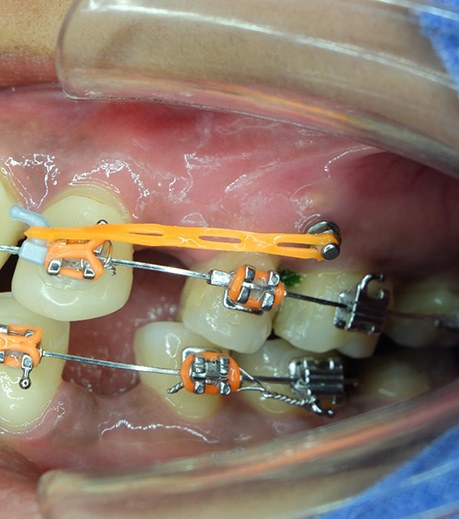
A TAD is a tiny surgical screw, which may be about the size of a typical earring post. It is placed into the gums, and it is used to anchor rubber bands or wires. The rubber bands wires are also connected to the braces brackets. With the help of a TAD, the braces can apply the pressure needed to carry out complex or challenging tooth movements.
As their name implies, TADs are temporary. They are only kept in the mouth for as long as is necessary to accomplish their purpose, which is typically several months. Since not everyone needs TADs, our team can let you know during your consultation if they may be beneficial in your unique case.
How Are TADs Placed?

While the idea of getting a screw placed into your gums might sound scary, the procedure is really nothing to be afraid of!
To start, our team will use advanced imaging equipment, such as a digital X-ray, to determine the best place to insert your TADs. The images help us avoid causing damage to your tooth roots.
When you are ready for the procedure, we will use local anesthetic to numb the area. You should not feel any pain, but you might experience some pressure as we create a small pilot hole and then insert the TADs into your gums and into the underlying bone tissue.
Once the anesthesia wears off, you may notice some soreness, but it tends to be temporary, and it is usually manageable with over-the-counter pain medications.
The Benefits of TADs

TADs can be beneficial in numerous ways:
- Efficient tooth movement: TADs provide stable anchorage, allowing orthodontists to move teeth more predictably. This can make challenging tooth movements possible and can help achieve desired results faster.
- Minimally invasive placement: The procedure to insert TADs is quick and requires only local anesthetic. Patients typically recover rapidly and experience little discomfort following placement.
- Versatility in treatment: TADs can be used in various orthodontic scenarios, including closing gaps, correcting bite issues, and adjusting tooth positions that might otherwise be difficult to treat.
- Simpler treatment: By providing a fixed point of anchorage, TADs often eliminate the necessity for bulky external appliances such as headgear, offering a more discreet treatment option. TADs may also reduce or eliminate the need for rubber bands between the upper and lower teeth, and they could even help you avoid the need for certain orthodontic surgeries.
- Temporary and removable: TADs are designed to be taken out once their purpose is served. This feature ensures that the accessory does not remain in the mouth longer than needed.
Temporary Anchorage Devices (TADs) FAQs
When Are TADs Typically Recommended?
Temporary Anchorage Devices (TADs) in Cumming may be recommended in specific situations to enhance treatment effectiveness and precision. Below are common scenarios in which TADs are typically suggested:
- Your orthodontic treatment requires precise movement of teeth that would otherwise be difficult or impossible with traditional braces alone.
- Certain teeth must be moved individually without impacting neighboring teeth.
- You are seeking correction of bite issues that require more stable anchorage than what braces or wires can provide. For example, TADs offer a reliable solution when treating conditions such as open bite, deep bite, or when significant molar movement is necessary.
Our orthodontic practice will carefully evaluate your unique needs and let you know whether TADs are required to help you achieve your smile goals.
Do TADs Come with Any Risks or Downsides?
While TADs are generally safe and effective, you should be aware of some risks and downsides. The placement of TADs requires a minor procedure, which may lead to temporary discomfort, swelling, or mild soreness at the site. There is also a slight risk of infection, which can be managed with proper oral hygiene and follow-up care.
In rare cases, a TAD may loosen or fail to integrate with the bone, requiring replacement or adjustment. You should let us know right away if you have any concerns that your TAD is not performing as expected.
How Many TADs Will I Need?
The number of TADs you need depends on your specific orthodontic goals and the complexity of your case. Some patients require only a single TAD, while others may need two or more to facilitate multiple tooth movements or achieve stable anchorage for correcting challenging bite issues.
During your consultation in one of our offices, your orthodontist will assess your teeth, jaw, and treatment plan to determine exactly how many TADs would be most effective. You will receive a clear explanation of the reasons for the recommended number, so you can feel confident about your treatment plan.
How Long Will My TADs Stay in My Mouth?
Your TADs will remain in your mouth for as long as they are needed to accomplish the desired tooth movements. This period may range from a few months to a year or longer, depending on the complexity of your orthodontic treatment and how quickly your teeth respond. Once TADs have fulfilled their purpose, your orthodontist will remove them during your regular visit with minimal discomfort.
Can I Get Orthodontic Treatment Without TADs?
Many patients receive orthodontic treatment without TADs. This may be possible for you if your dental issues are not complex or do not require additional anchorage. Traditional braces, aligners, and other appliances may be sufficient for bringing your teeth into proper alignment. However, if your treatment goals involve movements that cannot be accomplished with conventional methods, TADs may prove necessary to achieve the best results.
